
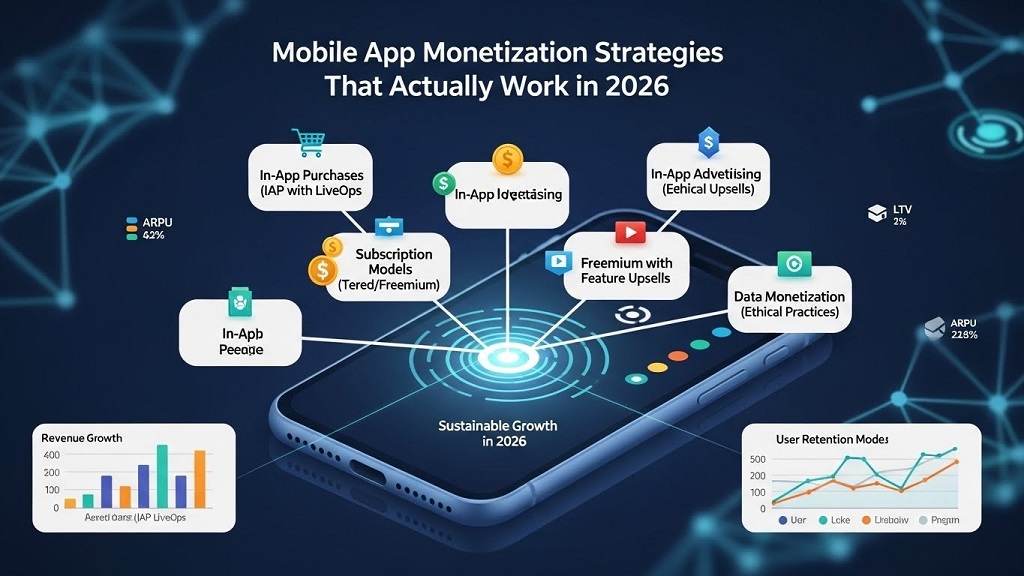
Different fintech app monetization strategies outline how financial technology apps convert value into sustainable revenue. For startups and established firms alike, choosing the right mix of revenue models determines growth speed, user retention and long-term profitability. This guide explains options, pros and cons, and practical steps to implement them.
Different fintech app monetization strategies: Overview
Fintech apps serve varied user needs—banking, investing, payments, lending, insurance and personal finance. Each niche suits certain monetization approaches. The best strategy balances user experience, regulatory constraints and scalability. Below we unpack proven revenue models, tools and how to combine them ethically and profitably.
Different fintech app monetization strategies — Subscription models
Subscription models charge users a recurring fee for premium features, higher limits, or advanced analytics. Monthly or annual plans are common. Subscriptions work well for budgeting apps, robo-advisors and premium banking services.
Different fintech app monetization strategies — Transaction fees
Transaction fees apply per payment, trade or transfer. They are common for payment processors, brokerage apps and peer-to-peer platforms. Fees can be flat, percentage-based or tiered by volume.
Different fintech app monetization strategies — Interchange and interchange split
Some apps earn a portion of card interchange fees when users pay with a card issued through the platform. This model fits neobanks and card-issuing fintechs and requires partner agreements.
Different fintech app monetization strategies — Lending spreads and interest
Lending platforms earn from the spread between borrower APRs and funding costs. This includes marketplace lending, buy-now-pay-later and microloan services.
Different fintech app monetization strategies — In-app purchases and feature upgrades
In-app purchases let users unlock one-off features, reports, educational content or advanced tools. This is useful for trading platforms and premium insights services.
Different fintech app monetization strategies — Advertising and affiliate partnerships
Relevant, non-intrusive advertising and affiliate referrals generate revenue when matched to user intent—e.g., mortgage offers, investment products or insurance. Always disclose partnerships and avoid conflicts of interest.
Different fintech app monetization strategies — Data monetization and insights
Aggregated, anonymized data can be sold as market insights or benchmarking reports. Privacy-first practices and compliance are mandatory.
What it is
Monetization is the set of methods a fintech app uses to generate revenue from users, transactions, partners or data. It shapes product design, pricing, marketing and legal frameworks. The ideal monetization stack aligns with user value and regulatory compliance while supporting growth metrics.
Why it matters
Choosing the right monetization strategy matters because it affects unit economics, user acquisition cost (CAC), lifetime value (LTV), churn and investor interest. The wrong model can reduce adoption or create regulatory risk. The right model accelerates scaling and ensures predictable cash flow.
Features / services / tools
Key features and tools that support monetization include:
- Flexible billing engine (subscriptions, usage-based billing)
- Secure payment gateway and settlement rails
- Compliance & KYC/AML integrations
- Analytics dashboard for LTV, churn, ARPU
- Feature-flagging and A/B testing for pricing experiments
- Partner API marketplace for affiliate and B2B integrations
- Encryption, data governance and consent management
Benefits
- Predictable revenue streams and better cash flow forecasting
- Improved user segmentation and targeted offers
- Higher customer lifetime value through premium tiers
- Scalable revenue as transaction volume grows
- Regulatory alignment and reduced compliance friction when built-in
- Faster investor traction with clear unit economics
Comparison table
| Model | Best for | Pros | Cons |
|---|---|---|---|
| Subscription | Budgeting, robo-advisors, premium banking | Predictable revenue, higher ARPU | Requires continuous value delivery; may increase churn |
| Transaction Fees | Payments, exchanges, remittance | Revenue scales with volume | Price-sensitive users; regulatory caps possible |
| Interchange | Neobanks, card programs | Passive revenue per transaction | Low margins per tx; depends on partnerships |
| Lending Spread | Marketplaces, BNPL | High margin potential | Credit risk; capital requirements |
| Ads & Affiliate | Mass-market apps | Low barrier to entry; incremental revenue | User experience risk; conflict of interest |
| Data Monetization | Platforms with large user base | High-margin revenue | Privacy, compliance and trust concerns |
Expert insight
Senior fintech product leaders emphasize experimentation. Start with a lean monetization hypothesis, run pricing A/B tests, and monitor unit economics. Combining low-friction models (free + ads) with premium upsells often outperforms single-model approaches. Regulatory alignment and transparent communication increase conversion and reduce churn.
For example, a neobank might pair interchange revenue with an optional subscription for higher ATM limits and concierge services. A trading app can combine commission-free trades (paid by market makers) with paid research and margin lending.
Use cases
Different fintech app monetization strategies — Neobank
Neobanks commonly combine interchange, subscription tiers, and FX or ATM fees. They focus on high activation rates and convert heavy users to paid plans.
Different fintech app monetization strategies — Investment platform
Investment platforms may use freemium trades, premium analytics subscriptions, margin lending and educational in-app purchases.
Different fintech app monetization strategies — Payments app
Payments apps use transaction fees, merchant subscriptions, and small-value lending to boost merchant retention and merchant-tailored services.
Pricing / cost overview
Pricing varies by model and vertical. Typical ranges:
- Subscription: $3–$50/month for consumer fintech; $100–$1,000+/month for SMB or API access
- Transaction fees: 0.1%–3% per transaction or flat $0.10–$2 per tx
- Interchange revenue: small percentage of each card transaction (varies by region)
- Lending: APR spreads depend on risk and funding cost; originator fees 0.5%–3%
- Affiliate/referral: CPA or revenue share, commonly $5–$200 per conversion
Initial implementation costs: payment integrations, compliance setup, legal review and engineering. Expect $50k–$500k for a compliant launch depending on scope.
FAQs
1. What is the most profitable fintech monetization strategy?
There is no one-size-fits-all. Profitability depends on market fit, margins and scale. Lending spreads and interchange can be high-margin but have higher operational and regulatory costs. Subscriptions provide steady revenue with predictable churn dynamics.
2. Can I combine multiple monetization models?
Yes. Combining models (e.g., free tier + subscription + partner offers) diversifies revenue and reduces dependence on a single stream. Ensure transparency and avoid degrading the core product experience.
3. How do regulations affect monetization?
Regulations affect fees, consumer disclosures, lending practices and data usage. Always consult legal counsel and incorporate KYC/AML and data protection early in the product design.
4. How do I price a subscription for a fintech app?
Start with value-based tiers, test multiple price points, track conversion and churn, and iterate. Offer clear feature differentials and trial periods to reduce friction.
5. Is selling user data a viable revenue source?
Selling raw personal data is risky and often prohibited. Aggregated, anonymized insights can be monetized if done ethically and in compliance with privacy laws and user consent.
Conclusion
Different fintech app monetization strategies shape how your product grows, scales and sustains itself. Choose a model that reflects customer value, regulatory realities and unit economics. Start small, experiment, and iterate toward a diversified revenue stack that balances user trust with profitability.
Ready to design the right monetization mix for your fintech app? Learn more about product-market fit and pricing strategy: [link: related topic] or explore integration patterns for payments and subscriptions: Fintech Brand Strategy: Build Trust and Scale Faster in 2026 , Fintech PPC Campaign Strategies for High-Quality Leads , Fintech Website Design Company for High-Converting Financial Brands
Contact our team to map a monetization roadmap and pilot plan tailored to your app.
Leave a Reply