
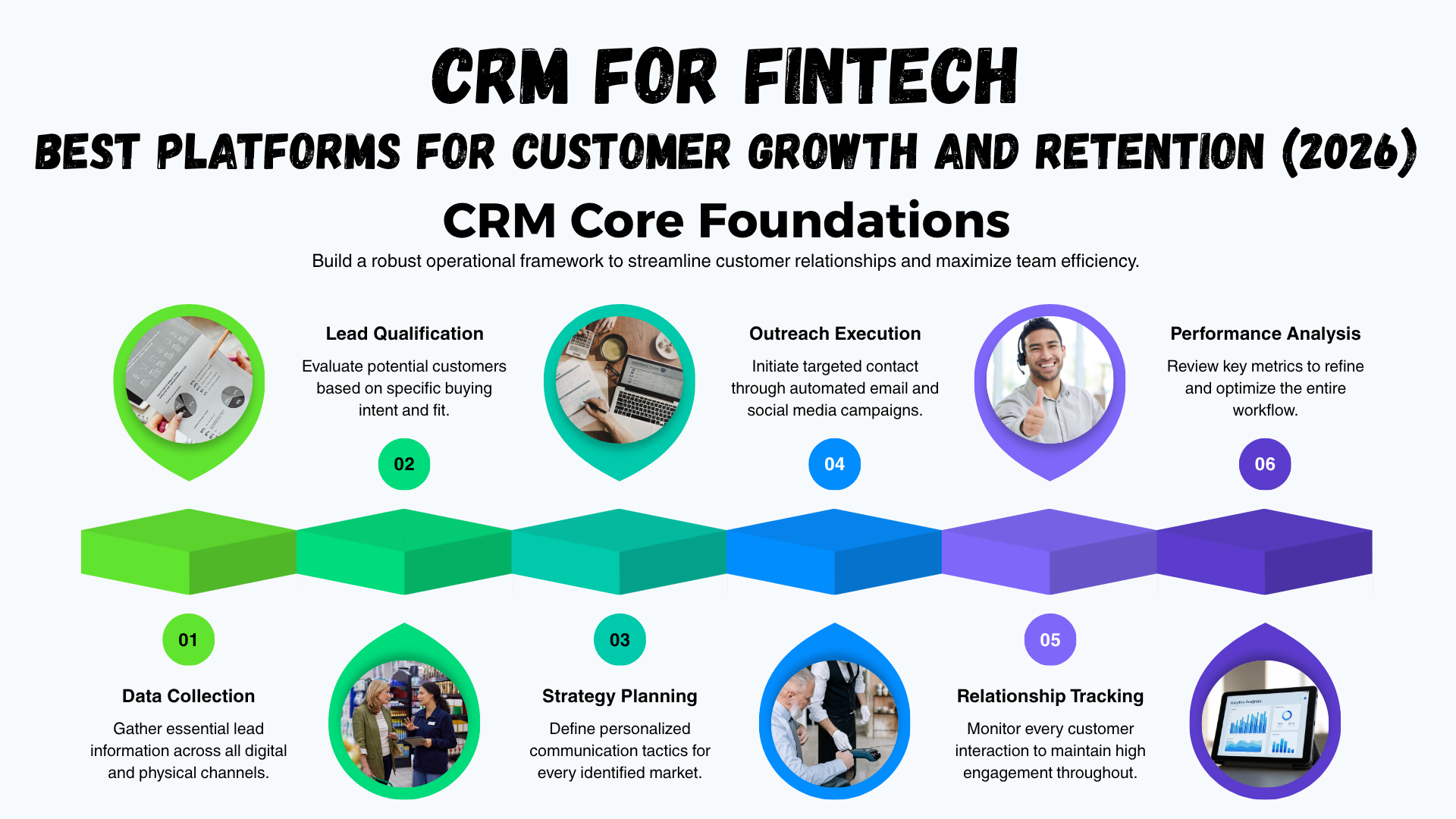
CRM for Fintech is the strategic combination of customer relationship management and financial technology designed to help fintech companies, banks, and financial institutions manage sensitive financial data, automate workflows, and deliver personalized services.
Beginner-friendly yet professional, this guide explains what a fintech CRM is, why it matters, the key features to look for, pricing models, use cases, and future trends through 2026 so teams can choose the best crm solution for their needs.
CRM for Fintech: Why a CRM matters to financial services and fintech companies
Financial services providers and fintech companies must balance compliance, security, and client relationships. A crm platform tailored for financial services centralizes customer information, provides a 360-degree view and ensures compliance with industry regulations.
With fintech growth, a dedicated fintech crm reduces manual data entry, improves customer interactions, and enables real-time decision making across sales teams and financial advisors.
What CRM for Fintech is and how it works
A fintech crm is a crm system customized to support financial workflows, core banking integrations, payment platforms and regulated financial processes.
It combines crm features like contact management, pipeline tracking, marketing automation and workflow automation with security features such as KYC, encryption and audit trails to protect sensitive financial data.
Why CRM for Fintech matters for financial institutions
CRM for fintech solutions help banks, fintech companies, and financial advisors provide personalized services at scale while ensuring compliance and robust security.
The result: improved customer experience, faster followup, and better cross-sell of financial products through predictive analytics and smart crm capabilities.
Key features of Fintech CRM and CRM solutions for financial services
Choosing the right crm involves matching core features to business needs. These crm features are essential for fintech and financial services providers.
Core CRM features tailored to fintech
- 360-degree view: Unified customer information across accounts, products and transactions.
- KYC and compliance tools: Automated identity verification and regulatory reporting.
- Workflow automation: Automate financial workflows like loan approvals and onboarding.
- Security and compliance: Encryption, role-based access and audit logs for sensitive financial data.
- Integration with financial systems: Core banking, payment platforms and trading systems.
- Predictive analytics and AI: Lead scoring, churn prediction and personalized product recommendations.
Advanced services and integrations
Top fintech crm solutions integrate with marketing automation (e.g., HubSpot), accounting, and third-party fintech APIs. Integration reduces duplicate data entry and streamlines the sales process and operations.
Many CRMs support custom workflows for regulated financial operations and pre-built connectors for Salesforce Financial Services Cloud, Zoho, and other providers.
Benefits of a Fintech CRM: Why financial services providers adopt CRM platforms
Adopting a crm for your financial services brings measurable benefits across sales, compliance and customer experience.
- Provide a 360-degree view of customers, improving cross-sell and retention.
- Automate onboarding and KYC to reduce manual tasks and human error.
- Improve followup and pipeline visibility for sales teams and financial advisors.
- Ensure compliance with industry regulations through audit trails and secure data handling.
- Enhance customer experience with personalized communications and timely recommendations.
- Reduce costs by streamlining operations and minimizing repetitive data entry.
Comparison table: Fintech CRM, Salesforce Financial Services Cloud, HubSpot and Zoho
| Feature | Fintech CRM (specialized) | Salesforce Financial Services Cloud | HubSpot (with integrations) | Zoho CRM (customized) |
|---|---|---|---|---|
| Designed for financial services | Yes — tailored workflows, KYC | Yes — industry-packed features | Partial — requires integrations | Partial — customizable modules |
| Security & compliance | Robust security, audit trails | Enterprise-grade security | Good security, needs add-ons | Good security, configurable |
| Integration with core banking/payment platforms | Native connectors common | Strong ecosystem, many partners | APIs available, needs work | APIs and marketplace |
| Workflow automation | Financial workflows prebuilt | Powerful automation & flows | Marketing & sales automation | Custom workflow engine |
| Predictive analytics / AI | Often included or add-on | Einstein AI for finance use cases | AI via integrations | Zia AI for predictions |
| Best for | Fintech companies, banks, advisors | Large financial institutions | SMBs and growth fintechs | Cost-conscious teams needing customization |
Expert insight on Fintech CRM and choosing the right CRM
Industry experts emphasize evaluating vendors on four pillars: security and compliance, integration capabilities, workflow automation, and AI-powered insights.
An effective fintech crm not only stores crm data but also orchestrates business processes, reduces risk, and scales with fintech growth. Prioritize solutions that provide a 360-degree view and robust security features for regulated financial operations.
Tips from practitioners
- Start with core use cases: onboarding, KYC, and pipeline management before adding marketing automation.
- Test integrations with your core banking and payment platforms early to avoid costly rework.
- Insist on role-based security and encryption for sensitive financial data.
Use cases for CRM for Fintech across financial services
Fintech crm solutions support a wide range of business processes in the financial services industry.
Use case: Retail banking and neo-banks
Banks use crm systems to track customer interactions, personalize offers and automate compliance checks for new accounts.
CRMs enable banks to enhance customer experience while maintaining robust security for sensitive financial data.
Use case: Wealth management and financial advisors
Financial advisors use crm for financial planning, client onboarding and to automate followup for portfolio reviews.
A crm tailored to advisors improves client retention and offers predictive analytics for financial product recommendations.
Use case: Lending and credit fintechs
Lenders use fintech crm to automate loan origination workflows, integrate with credit scoring and ensure transparent audit trails.
Automation reduces cycle times and helps sales teams manage pipeline more effectively.
Use case: Payments and merchant services
Payment platforms integrate crm data for merchant onboarding, dispute management and personalized merchant support.
Integration reduces duplicate data entry and improves resolution times for customer interactions.
Pricing and cost overview for CRM for Fintech
Pricing models vary: subscription per user per month, tiered packages, and enterprise licensing. Specialized fintech crm solutions often include premium fees for compliance modules and integrations.
Typical cost components: base subscription, add-on modules (KYC, AI), integration/setup, and ongoing support. Expect higher costs for enterprise-grade security and custom connectors to core banking.
Sample pricing tiers
- Starter: $25–$75/user/month — basic CRM, limited automation (best for small fintech startups).
- Growth: $75–$200/user/month — advanced automation, integrations, and predictive analytics.
- Enterprise: $200+/user/month — full security, compliance modules, SLAs and custom integrations.
Many vendors offer professional services for implementation; budgeting 3–6 months and 15–25% of annual license cost for initial setup is common for regulated financial projects.
Common mistakes when implementing a CRM for financial services
Implementations can fail when teams underestimate complexity or ignore compliance. Avoid these common pitfalls.
Top implementation mistakes
- Skipping integration tests with core banking and payment platforms.
- Over-customizing before validating workflows leads to upgrade headaches.
- Neglecting security policies for sensitive financial data and role-based controls.
- Ignoring end-user training sales teams and financial advisors need workflow training to reduce data entry errors.
- Failing to map regulatory requirements into the crm (audit logs, data retention).
Future trends for CRM for Fintech by 2026
By 2026 fintech crm systems will be smarter, more connected and more regulated-aware. Expect AI-driven financial insights, deeper banking integrations, and stronger controls for data privacy.
Key trends include embedded AI for predictive financial planning, automated compliance using natural language processing, and increased adoption of real-time data flows between CRMs and core banking.
What to watch
- Predictive analytics will drive proactive customer outreach and personalized financial product offers.
- Regtech integration will automate regulatory reporting and KYC at scale.
- APIs and open banking will enable faster integrations with payment platforms and fintech ecosystems.
Choosing the right CRM for your financial services: checklist
When choosing the right crm evaluate compliance, integration flexibility, automation capabilities, and vendor experience in the financial services industry.
- Does the crm ensure compliance and robust security for sensitive financial data?
- Can it integrate with your core banking and payment systems?
- Are there prebuilt financial workflows and KYC tools?
- Does the vendor support predictive analytics and AI use cases?
- What are the total cost of ownership and professional services required?
B2B Fintech SEO: How Financial Brands Generate High-Value Organic Leads (2026) , SEO Strategies for Fintech Companies: Proven Ways to Increase Organic Growth (2026) , Fintech Executive Search Firms: Top Recruiters for Financial Technology Leaders (2026)
Common questions: FAQs about CRM for Fintech
1. What is CRM for Fintech and how does it differ from a standard CRM?
CRM for Fintech is a crm tailored to the financial services industry, with built-in KYC, audit trails, strong encryption, and integrations to core banking and payment platforms. It focuses on security, compliance and financial workflows compared to generic CRMs.
2. How does a fintech crm help ensure compliance and security?
Fintech crm solutions include role-based access, encryption, immutable logs, automated compliance workflows and KYC/AML modules to help regulated financial institutions meet industry regulations.
3. Which crm is best for financial services: Salesforce, HubSpot, Zoho, or specialized fintech CRMs?
There is no one-size-fits-all. Salesforce Financial Services Cloud is ideal for large institutions, HubSpot and Zoho can work for growth fintechs with integrations, while specialized fintech crm solutions often offer the best out-of-the-box compliance and workflows.
4. Can CRM for Fintech integrate with core banking and payment platforms?
Yes. Modern fintech crm platforms provide APIs and native connectors to integrate with core banking, payment platforms and other financial systems to reduce data entry and enable real-time operations.
5. How much does CRM for Fintech cost and what affects pricing?
Costs range widely: $25–$200+/user/month depending on features, compliance modules, integrations and enterprise services. Costs increase with higher security, custom integrations and professional services.
Conclusion: CRM for Fintech make customer relationships a competitive advantage
CRM for Fintech is essential for any fintech company or financial services provider that wants to improve customer relationships, automate financial workflows, and ensure compliance with industry regulations.
Choose a solution that provides a 360-degree view, robust security, workflow automation, and integration with your financial systems. Start small, validate core use cases, and scale automation to realize the benefits.
Ready to evaluate fintech crm solutions and find the best crm for your financial services? Contact an expert, run a pilot, and measure ROI on onboarding speed, pipeline conversion and compliance efficiency.
Take action now: test a crm pilot with your key workflows and reduce manual work while improving customer experience.
Leave a Reply