
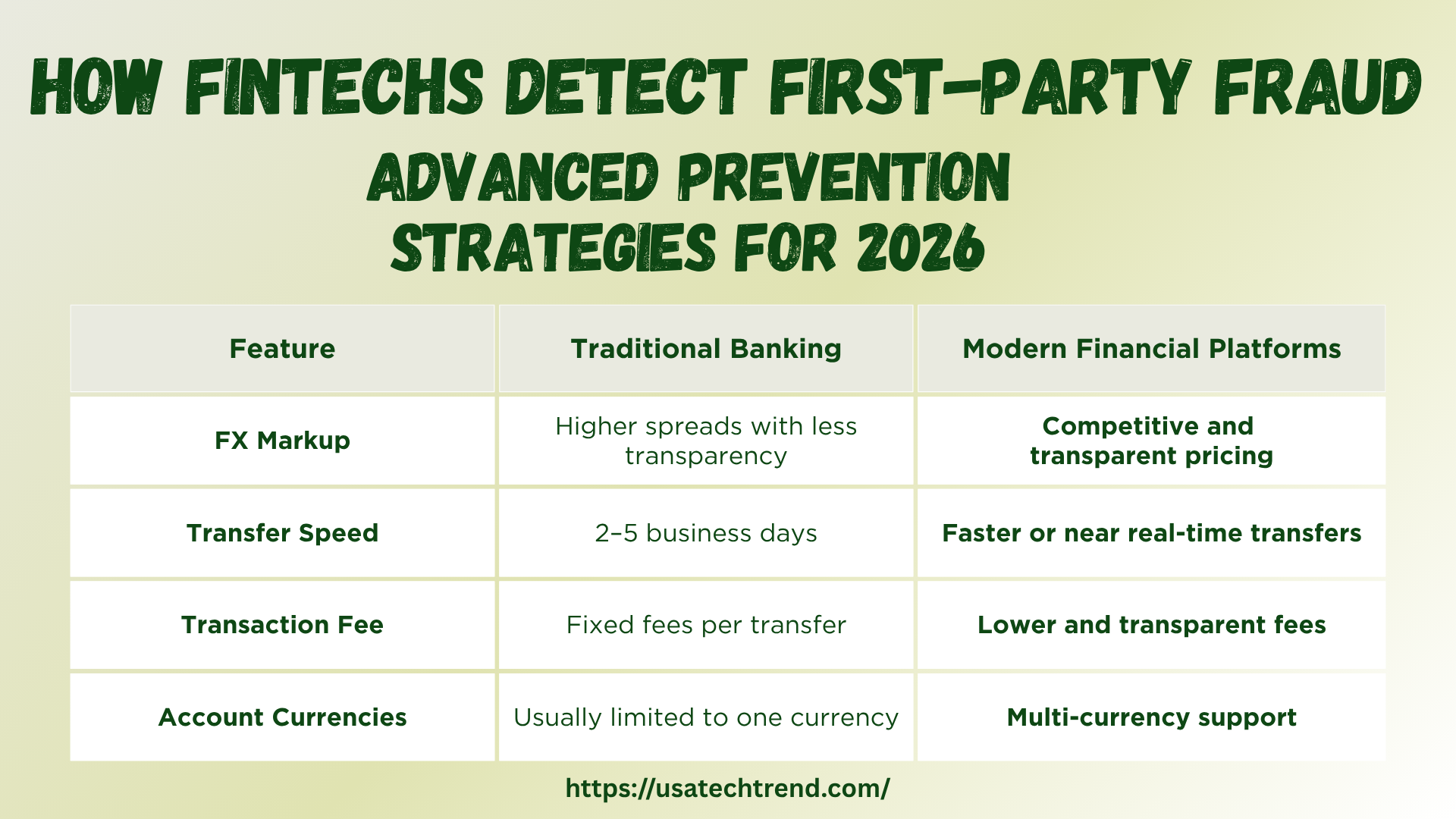
How Fintechs Detect First-Party Fraud begins with understanding that the fraudster is the account holder or applicant who misrepresents information to gain financial benefit.
This article explains what first-party fraud is, why it matters to fintech services, and the detection methods modern fintechs use to reduce losses while maintaining a smooth customer experience.
How Fintechs Detect First-Party Fraud: What it is
First-party fraud occurs when a legitimate customer intentionally provides false information or misuses services to obtain credit, cash, or benefits they do not intend to repay.
It includes staged identity, friendly fraud, loan stacking, and synthetic behavior at the account level. Detection requires behavioral analysis, identity validation, and risk scoring tailored to authentic-user patterns.
How Fintechs Detect First-Party Fraud: Why it matters
First-party fraud undermines revenue, increases customer acquisition costs, and distorts underwriting models.
Unlike third-party fraud, it is harder to spot because the perpetrator controls the account and often passes basic KYC checks, making advanced detection essential for sustainable growth.
Financial and reputational impact
Charge-offs, legal costs, and increased reserve requirements are direct impacts.
Indirect effects include poor portfolio performance, damaged investor trust, and higher compliance scrutiny.
Operational strain on teams
Investigation teams spend disproportionate time on disputes and manual reviews when first-party fraud scales.
Automation and reliable detection reduce operational burden and false positives.
Key features and services used to detect first-party fraud
Fintechs deploy layered systems that combine identity verification, behavioral analytics, and risk orchestration.
Key components integrate data enrichment, device intelligence, and adaptive decisioning engines.
Identity verification and document analytics
Document OCR, liveness checks, and cross-checks against authoritative databases help detect fabricated or manipulated IDs.
Advanced solutions use forensic analysis to flag inconsistencies across documents and metadata.
Behavioral biometrics and device intelligence
Keystroke patterns, touch dynamics, device fingerprinting, and network signals reveal unusual behavior inconsistent with the claimed identity.
These signals are particularly effective for detecting account takeover and friendly fraud attempts.
Machine learning and anomaly detection
Supervised and unsupervised models learn normal account lifecycles and surface anomalies like sudden credit usage spikes or atypical repayment patterns.
Real-time scoring enables instant decisioning on loan approvals, credit line increases, or payouts.
Link analysis and network graphs
Graph-based approaches uncover hidden relationships between accounts, IPs, and devices, revealing networks of fraudulent actors or repeated exploit patterns.
They also detect loan stacking and coordinated applications across products.
Risk orchestration and workflow automation
Decision orchestration layers combine signals into a single risk verdict and trigger tailored workflows: soft review, escalate to KYC, or automatic denial.
This reduces manual workload and standardizes responses across channels.
Benefits of effective first-party fraud detection
- Reduce charge-offs and write-offs through early detection.
- Lower false positives to improve customer experience.
- Optimize underwriting and pricing with cleaner data.
- Shorten investigation times with automated workflows.
- Preserve brand reputation and investor confidence.
How Fintechs Detect First-Party Fraud: Comparison of common detection approaches
| Approach | Strengths | Weaknesses | Best use |
|---|---|---|---|
| Rules-based systems | Simple, transparent, low latency | Rigid, high false positives at scale | Early screening and compliance checks |
| Machine learning models | Adaptive, finds complex patterns | Requires labeled data, can be opaque | Behavioral and anomaly detection |
| Behavioral biometrics | High accuracy for account-level fraud | Privacy concerns, device variability | Account takeover and inside fraud |
| Graph analytics | Detects networks and coordinated fraud | Complex implementation | Loan stacking and networked schemes |
| Third-party identity providers | Authoritative identity checks | Can be circumvented by first-party actors | KYC and onboarding |
How to combine approaches
Best results come from hybrid systems: rules filter obvious fraud, ML handles nuance, biometrics confirm account control, and graph analytics spot networks.
Orchestration routes cases to the correct remediation path for a balanced risk/experience tradeoff.
Expert insight: How fintechs detect first-party fraud effectively
Senior fraud leaders recommend focusing on signal diversity and model explainability.
Combining device, behavioral, and transactional signals with contextual business rules yields robust detection while keeping customer friction low.
Experts also emphasize continuous model retraining, cross-team playbooks, and privacy-by-design to stay ahead of adaptive fraudsters.
Use cases where fintechs detect first-party fraud
Online lending
Lenders detect staged identities and loan stacking by correlating application signals with repayment behavior and device history.
Real-time decisioning prevents disbursing funds to high-risk applicants.
Buy now, pay later (BNPL)
BNPL providers monitor split purchases, rapid reapplications, and return abuse patterns to flag friendly fraud and serial bad actors.
Soft declines and enhanced verification reduce losses while preserving conversion.
Digital wallets and payouts
Fintechs verify payee identity and monitor payout velocity to stop account misuse and money mule activity.
Behavioral analytics help validate that the wallet owner is the legitimate user.
Account opening and KYC
Onboarding uses liveness checks, document analytics, and risk scoring to prevent fake account creation.
Continuous monitoring after onboarding catches changes in behavior indicative of first-party fraud.
Pricing and cost overview for detection tools
Pricing models vary: subscription, per-transaction, or hybrid.
Per-transaction pricing suits volume-variable fintechs; subscription models work for predictable volumes and full-suite platforms.
Typical cost components
- Per-check fees for identity and device intelligence.
- Monthly subscription for analytics and dashboards.
- Implementation and integration fees.
- Ongoing model tuning and support costs.
Budgeting guidance
Start with a proof-of-value on high-risk flows and scale to full coverage as ROI is proven.
Expect initial setup costs but decreasing marginal cost per detection as signals and automation reduce manual reviews.
Common mistakes fintechs make when detecting first-party fraud
Relying solely on static rules
Static rules are easy to bypass and cause many false positives as fraud evolves.
Layer ML and adaptive rules to remain flexible.
Prioritizing frictionless UX over risk controls
Balancing experience and safety is essential; removing all friction invites losses, adding too much kills growth.
Use progressive verification to escalate only when risk indicators appear.
Ignoring data quality and context
Poor data labeling and missing context degrade model performance.
Invest in data enrichment and feedback loops from investigations.
Underestimating privacy and compliance
Collecting signals without privacy safeguards risks regulatory fines and customer trust.
Adopt privacy-by-design and document DPIAs for biometric and device data.
Future trends in how fintechs detect first-party fraud (2026)
By 2026 detection will be more real-time, privacy-preserving, and integrated across ecosystems.
Expect wider adoption of federated learning, on-device biometrics, and shared anonymized threat intelligence among regulated players.
Federated and edge models
Models trained across institutions without sharing raw data will increase signal richness while protecting privacy.
This enables better detection of cross-platform fraud like loan stacking without centralized data pooling.
Privacy-preserving signals
Differential privacy and secure multiparty computation will let fintechs use sensitive signals like behavior without exposing raw customer data.
Regulators and consumers will demand stronger guarantees as behavioral data use grows.
AI explainability and regulatory alignment
Expect stricter explainability requirements; leading fintechs will deploy transparent ML with counterfactual reasoning for decisions.
That improves dispute handling and auditability.
How Fintechs Detect First-Party Fraud: FAQs
1: What is the fastest way to detect first-party fraud?
The fastest method combines real-time device intelligence with anomaly scoring on transaction patterns; these surface high-risk cases for immediate review or automated decline.
2: Can first-party fraud be fully prevented?
No system prevents all fraud, but layered defenses, continuous monitoring, and cross-channel signals can reduce losses to manageable levels while preserving customer experience.
3: How do privacy rules affect detection?
Privacy regulations require minimizing data, lawful basis for processing, and secure handling of biometric data; fintechs must document practices and use privacy-enhancing technologies when possible.
4: What metrics should fintechs track?
Track charge-off rate, false positive rate, manual review load, time-to-resolution, and detection recall/precision to evaluate efficacy and ROI.
5: When should a fintech outsource detection vs build in-house?
Outsource when lacking scale or expertise; build in-house when fraud patterns are product-specific and require tight integration with underwriting and user flows.
Conclusion
How Fintechs Detect First-Party Fraud is an evolving discipline that blends identity science, behavioral analytics, and intelligent orchestration to protect revenue and customer experience.
The best fintechs use layered defenses, continuous model improvement, and privacy-first practices to stay ahead of adaptive fraudsters.
Ready to reduce losses and improve customer trust? Start with a targeted pilot on your highest-risk product, measure lift, and scale the signals that work.
Call to action: Evaluate your current detection stack today — run a proof-of-value on device intelligence or behavioral analytics and link outcomes to reduced charge-offs.
Hire Fintech Developers: Complete Guide to Finding Top Fintech Talent in 2026 , Fintech VC Firms: Top Venture Capital Investors for Fintech Startups in 2026 , Fintech Software Outsourcing: Complete Guide to Building Secure Financial Solutions in 2026
Leave a Reply