
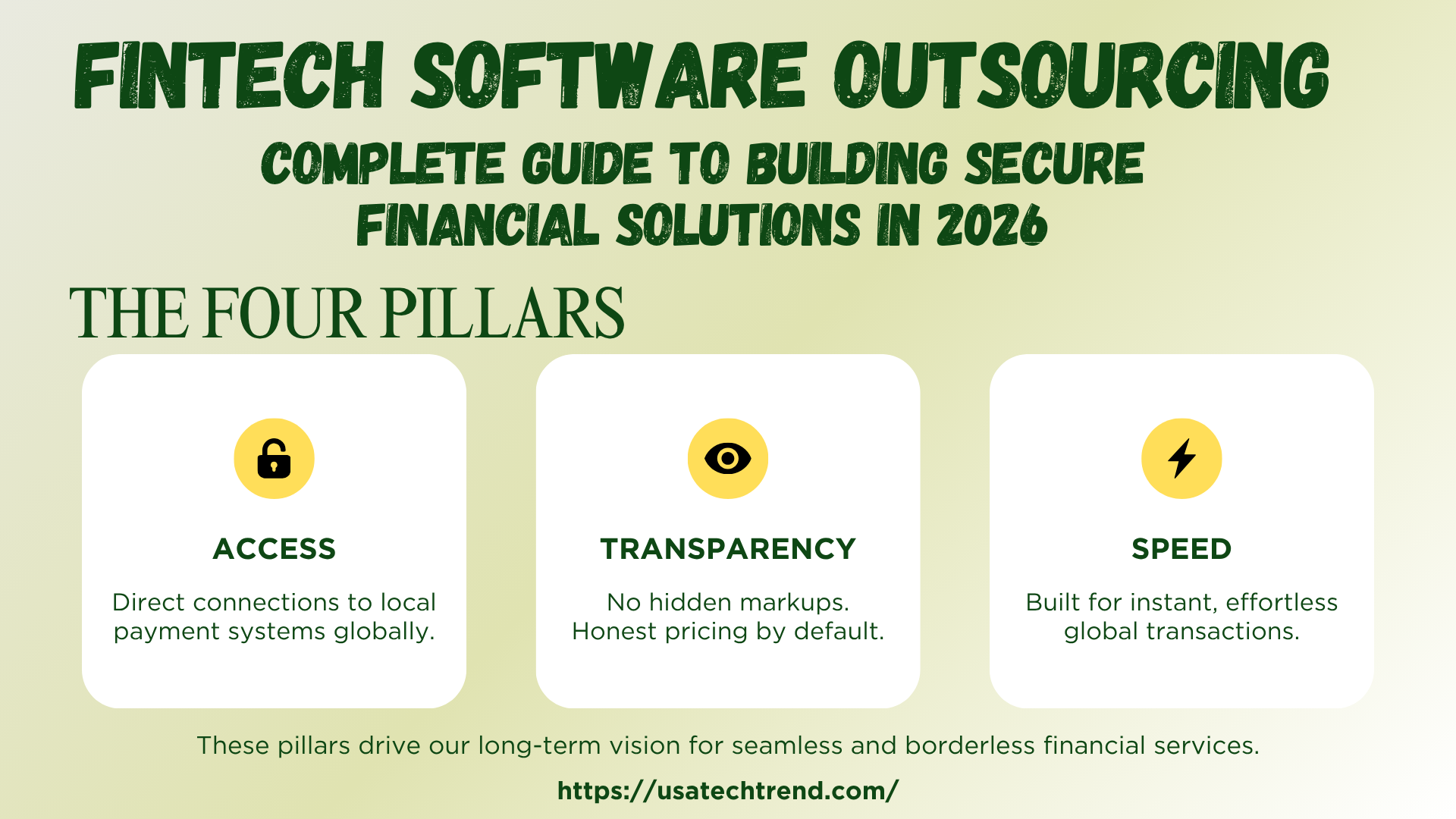
Fintech software outsourcing is the strategic delegation of financial technology development tasks to external vendors, agencies, or development partners. This approach covers everything from custom fintech platforms and payment gateways to digital banking solutions and regulatory technology (RegTech).
Whether you’re a fintech startup or an established financial services company, understanding how to outsource fintech software development effectively can accelerate time-to-market, control costs, and bring specialized expertise to complex compliance and security challenges.
Why outsource fintech development: Why fintech software outsourcing matters
Outsource fintech development when your organization needs domain-specific technical skills, faster delivery, or flexible resourcing without committing to long-term hiring.
Fintech software outsourcing matters because it blends software development services with financial domain expertise, allowing companies to innovate while managing compliance, data privacy and performance at scale.
What fintech software outsourcing is
Fintech software outsourcing involves contracting an external team for financial software development services: architecture, front-end and back-end coding, cloud infrastructure, security, and integration with banking APIs.
It can be full-project outsourcing, staff augmentation, or a hybrid model aligned to your product roadmap.
Why fintech outsourcing matters for startups and enterprises
Startups gain access to seasoned engineers and product managers without heavy upfront hiring costs. Enterprises benefit from niche skills like blockchain, AI for fraud detection, or real-time payments expertise.
Outsourcing also provides geographical diversity for business continuity and cost arbitrage advantages.
Key features and services offered by fintech software development outsourcing partners
Top outsourced fintech vendors provide a suite of services from initial discovery to ongoing maintenance and support.
- Custom fintech software development: core banking, lending platforms, digital wallets.
- API development & integration: PSD2, Open Banking, SWIFT, ACH connectors.
- Security & compliance: KYC/AML tooling, encryption, SOC2/GDPR readiness.
- Cloud & DevOps: scalable infrastructure, CI/CD pipelines, disaster recovery.
- Data engineering & AI: risk models, fraud detection, credit scoring, analytics.
- UX/UI design & product strategy: compliant, accessible interfaces for fintech users.
Specialized fintech development services to look for
Search for vendors experienced in payment processing, card issuing, lending workflows, compliance automation and third-party banking integrations.
Expertise in blockchain, tokenization, and smart contracts can be important for certain product types.
Benefits of fintech software outsourcing for companies outsource development
When companies outsource development, they can unlock strategic and operational benefits that directly impact growth.
- Faster time-to-market through parallelized teams and established delivery processes.
- Cost efficiency via lower overhead and region-based pricing.
- Access to niche financial domain expertise and mature security practices.
- Scalability: scale teams up or down according to product cycles.
- Risk mitigation: shared responsibility for compliance and operational security.
- Focus on core business strategy while development partner handles technical execution.
How benefits differ for fintech startups vs established financial firms
Startups primarily gain speed and cost control, while enterprises benefit from additional capacity, innovation injection and legacy system modernization support.
Both can leverage outsourced fintech talent to test new product ideas or enter new markets without heavy capital expenditure.
Comparison: Fintech software development outsourcing vs in-house fintech development
| Criteria | Fintech Software Outsourcing | In-house Development |
|---|---|---|
| Speed | Typically faster due to ready teams and processes | Slower—requires hiring and ramp-up |
| Cost | Lower initial cost; predictable pricing models | Higher long-term payroll and infrastructure costs |
| Domain Expertise | Access to specialized fintech skills | May require training or hiring specialists |
| Control | Less direct control; requires strong governance | Full control over priorities and culture |
| Security & Compliance | Vendor-dependent; often highly mature for vendors focused on finance | Internal ownership; requires investment in controls |
When to choose outsourced fintech vs building internally
Choose outsourced fintech when you need speed, cost predictability, or specialized skills not available internally. Build internally for long-term core IP, highly sensitive platforms, or when you need tight cross-functional alignment.
Many organizations adopt a hybrid approach: strategic core built in-house, modular services outsourced.
Fintech development outsourcing cost: Pricing and cost overview
Fintech development outsourcing cost varies by region, complexity, and the engagement model you select.
Typical pricing models include fixed-price for well-defined scope, time-and-materials for evolving projects, and dedicated teams for long-term partnerships.
Estimate ranges (ballpark)
Simple fintech modules or integrations: $30k–$80k.
Mid-size platforms (lending, digital wallet): $150k–$600k.
Large-scale core banking or neobank builds: $600k–$3M+, depending on compliance, infrastructure and third-party licensing.
Factors that drive cost
Regulatory compliance, security certifications, third-party licenses, number of integrations, SLA levels and ongoing maintenance affect total cost of ownership.
Choosing a nearshore or offshore outsourcing partner can reduce hourly rates but requires stronger governance to maintain quality.
Expert insight: How to choose the right fintech development outsourcing partner
Experts advise evaluating both technical capability and fintech-specific experience. Look for evidence of past projects, security practices, and regulatory knowledge.
Conduct technical interviews, request architecture blueprints, and ask for references specifically in payments, lending, or banking—whichever domain your product targets.
Checklist to vet a fintech outsourcing partner
- Domain case studies and client references.
- Security certifications (ISO27001, SOC2) and GDPR compliance.
- Clear SLAs, escalation paths, and IP ownership terms.
- Transparent pricing and a defined onboarding process.
- Product management and UX capabilities, not just coding.
Red flags to watch for
Lack of regulatory experience, unclear ownership of code/IP, vague security controls, and inconsistent communication are major warning signs.
Also be cautious if a vendor lacks experience with the fintech platforms or APIs you must integrate.
Use cases: Outsourced fintech solutions across the fintech industry
Outsourced fintech development supports a wide range of product types and industry needs.
Common use cases
- Digital banking and neobanks: core banking engines, onboarding flows, mobile apps.
- Payment processing: card issuing, merchant gateways, ACH and SWIFT integrations.
- Lending platforms: loan origination, credit scoring, servicing, collections.
- Investment and wealth tech: robo-advisors, portfolio rebalancing engines.
- RegTech solutions: automated KYC/AML, reporting and audit tooling.
- InsurTech components: claims automation and pricing engines.
Each use case demands tailored security, compliance and performance considerations.
Common mistakes when companies outsource fintech development
Even experienced companies make predictable errors when outsourcing fintech projects. Recognizing them helps avoid costly rework.
Top common mistakes
- Poorly defined requirements leading to scope creep.
- Ignoring compliance needs early in design.
- Underestimating integration complexity with legacy systems.
- Overemphasis on cost rather than outcomes and security.
- Weak governance and lack of regular checkpoints.
Mitigate these by investing in a solid discovery phase, compliance consultations, and regular demos.
Future trends in fintech software outsourcing (2026 outlook)
By 2026, fintech outsourcing will be shaped by AI-first platforms, composable banking, and heightened regulation across jurisdictions.
Expect growth in outsourced services for AI-driven fraud detection, explainable credit scoring, and secure tokenization for digital assets.
Key trends to watch
- Shift to AI/ML-enabled outsourcing services for risk and compliance automation.
- Increased demand for cloud-native, serverless fintech architectures.
- Greater focus on privacy-preserving computing and secure multi-party computation for shared financial workflows.
- Rise of platformized outsourcing: vendors offering modular fintech building blocks and fintech-as-a-service.
How to structure a fintech outsourcing engagement: Development partner and governance
Successful fintech outsourcing engagements blend clear contracts, milestones, and joint ownership of outcomes.
Define KPIs, security requirements, test plans, and a detailed transition plan from day one.
Suggested engagement phases
- Discovery and compliance assessment.
- Architecture design and security review.
- Incremental development sprints with regular demos.
- Integration, testing, and regulatory validation.
- Go-live, monitoring and ongoing support.
Include post-launch SLAs and a roadmap for iterative feature delivery.
Pricing models and contract tips for fintech software outsourcing
Negotiate contracts that balance cost predictability with flexibility: fixed-price for discovery, time-and-materials for iterative build, and dedicated teams for long-term support.
Protect your IP with clear ownership clauses and include exit terms for smooth transitions if you choose to change vendors.
Conclusion: Fintech software outsourcing as a strategic accelerator
Fintech software outsourcing is a powerful lever to accelerate product development, access specialized skills, and manage cost while navigating complex regulatory and security requirements.
Choose a partner with proven fintech experience, strong security posture, and transparent processes to maximize the benefits of outsourcing and reduce operational risk.
Ready to evaluate partners or define your outsourcing strategy? Contact our team to start a compliant, secure fintech development engagement today.
Fintech Recruiting Firms: Best Talent Partners for Fintech Companies in 2026 , Fintech Licensing: Complete Guide to Regulatory Compliance & Business Success in 2026 , Fintech Management Consultants: Top Consulting Experts for Business Growth in 2026
FAQs about Fintech Software Outsourcing
1. What is fintech software outsourcing and how does it work?
Fintech software outsourcing is hiring an external vendor to design, build, and maintain financial software. It works through engagement models such as fixed-price projects, dedicated teams, or staff augmentation, with clear SLAs and governance.
2. How much does fintech development outsourcing cost?
Costs vary widely: simple modules $30k–$80k, mid-size platforms $150k–$600k, large core systems $600k–$3M+. Region, compliance needs, and integrations drive the final price.
3. How do I ensure compliance when outsourcing fintech development?
Require vendors to demonstrate regulatory experience, security certifications, and include compliance milestones in contracts. Conduct audits, threat modeling, and include a compliance officer in governance.
4. What are the risks of fintech software outsourcing?
Main risks are data security, regulatory non-compliance, loss of IP control, and misaligned delivery expectations. Mitigate these with contracts, technical audits, and transparent communication channels.
5. When should a fintech company choose to outsource vs build in-house?
Outsource for speed, niche expertise, or flexible resourcing. Build in-house when your platform is core IP requiring tight integration with internal processes, culture, or long-term ownership.
For tailored guidance on whether to outsource or build, speak with a fintech development advisor.
Leave a Reply