
How to Create Fintech Content for Sales Teams is a practical guide to designing targeted, compliant, and high-converting content that accelerates pipeline and supports long sales cycles in financial technology.
This article explains what fintech content for sales teams is, why it matters, and how to build a content strategy that aligns marketing and sales to generate qualified leads and measurable ROI.
Fintech content marketing: What it is and why it matters
What it is: Defining fintech content for sales enablement
Fintech content marketing for sales teams combines educational content, case studies, product collateral, and thought leadership to help fintech sales reps move prospects through complex B2B sales cycles.
It typically includes whitepapers, datasheets, demo scripts, playbooks, and tailored assets that address buyer pain points and regulatory concerns.
Why it matters: Impact on pipeline, trust, and revenue growth
High-quality fintech content builds trust and credibility with sophisticated fintech buyers, shortens the sales cycle, and improves conversion rates.
When marketing and product teams align on messaging, sales teams get the resources to handle objections, demonstrate compliance, and close deals — improving overall revenue growth and ROI.
Content strategy and fintech marketing strategies for sales teams
Key features and services of a fintech content strategy
A robust fintech content strategy for sales teams includes persona mapping, content pillars, gated assets, SEO, automation, and analytics to measure funnel performance.
Services may include content creation, compliance review, design, distribution, and performance reporting to ensure a consistent message across channels.
Core content types to create for B2B fintech sales
Prioritize: case studies, ROI calculators, solution briefs, demo videos, regulatory FAQs, and customized playbooks for sales reps.
Educational content and thought leadership support top-of-funnel awareness, while product teams provide technical collateral for later-stage decision-making.
Align fintech marketing and sales for maximum impact
Establishing clear communication channels between marketers, sales reps, and stakeholders ensures content addresses real buyer pain points and results in sales-qualified leads.
Use shared dashboards and regular cadences to iterate on messaging and improve conversion metrics.
Best practices for fintech companies: Build trust and compliance
Compliance and regulatory considerations
Comply with financial services regulations by embedding legal review into the content workflow and keeping disclaimers clear and up to date.
Document versioning and audit trails help maintain trust and protect the brand during audits or product changes.
Data-driven content: Analytics and ROI measurement
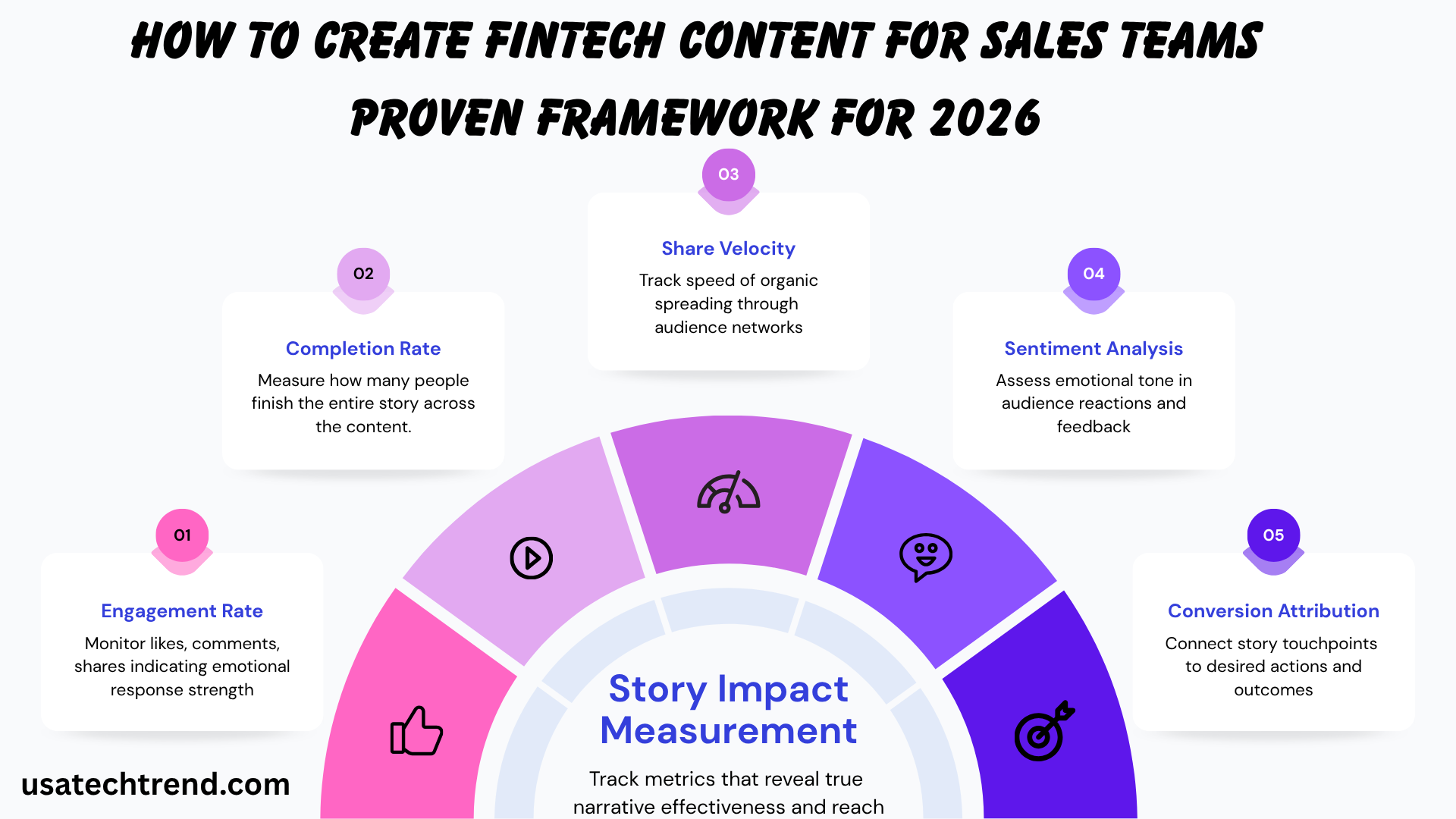
Track metrics like lead quality, sales qualified leads, time to close, engagement rates, and content-attributed revenue to quantify success.
Use analytics to find content gaps, optimize distribution channels, and demonstrate to stakeholders the direct impact on pipeline and ROI.
Fintech sales enablement: Benefits of tailored content
Benefits of investing in fintech content for sales teams
- Improved lead qualification and higher conversion rates.
- Shortened sales cycle through educational resources and objection handling.
- Stronger brand credibility and trust with fintech buyers.
- Better alignment between marketing, sales, and product teams.
- Scalable resources for onboarding new sales reps and international markets.
How content increases pipeline and revenue growth
Targeted content helps move leads from awareness to evaluation by answering the questions buyers have during each stage of the funnel.
When content maps to the buyer journey, sales reps can focus on closing, relying on assets to handle technical and compliance queries.
Content creation and marketing channels: Strategies for fintech marketers
Creating high-quality content that resonates with B2B fintech buyers
Start with buyer personas and map content to pain points, decision criteria, and procurement timelines typical in the fintech sector.
Invest in case studies that highlight metrics, testimonials, and specific outcomes to build trust and demonstrate expertise in financial technology.
Distribution channels and automation
Use email automation, LinkedIn thought leadership, targeted paid search, and programmatic campaigns to reach fintech decision-makers.
Marketing automation platforms help nurture leads and sync behavior data to CRM for personalized outreach by sales reps.
Comparison: Content marketing strategies vs. traditional sales collateral
| Aspect | Content Marketing Strategy | Traditional Sales Collateral |
|---|---|---|
| Purpose | Educate, attract, and nurture across funnel stages | Support closing and product specs |
| Audience | Targeted personas, inbound fintech buyers | Prospects in evaluation/negotiation |
| Format | Articles, case studies, videos, calculators | Datasheets, brochures, slide decks |
| Measurement | Engagement, MQLs, content-attributed revenue | Deal velocity, win rate |
| Compliance | Integrated legal review workflows | Often static, updated less frequently |
Use cases: How fintech organizations use content to help fintech sales
Use case 1 — Enterprise payments platform
Sales teams use ROI calculators and vertical-specific case studies to demonstrate cost savings and regulatory compliance to treasury teams.
Use case 2 — Lending-as-a-service provider
Product deep-dives, sample contracts, and whitepapers address underwriting concerns and speed up procurement cycles with banks.
Use case 3 — B2B fintech startup scaling to enterprise
Thought leadership and analyst reports build credibility while sales enablement kits help reps tailor pitches to different stakeholders.
Pricing and cost overview for fintech content services and production
In-house vs. agency: Cost drivers
In-house teams incur salaries, tools, and training costs; a fintech marketing agency provides expertise, compliance review, and scalable production but at an agency fee.
Costs vary: expect a range from $5,000–$30,000+ per month depending on content volume, complexity, and distribution spend.
Budget allocation recommendations
Allocate budget across creation (40%), distribution/paid media (30%), tools & analytics (15%), and compliance/legal reviews (15%).
Prioritize ROI-focused assets like case studies and demos for early investments.
Common mistakes fintech marketers and sales teams make
Top pitfalls and how to avoid them
1) Ignoring compliance: incorporate legal checks into the workflow to prevent delays.
2) Overly technical messaging: translate product features into customer outcomes and ROI.
3) Poor alignment with sales: schedule regular content reviews with sales reps for real-world feedback.
4) No measurement plan: define metrics tied to pipeline and revenue before production begins.
Expert insight: Perspectives from fintech marketers and sales leaders
What industry experts recommend
“Map every piece of content to a stage in the sales cycle and a measurable outcome. That discipline ensures marketing contributes directly to pipeline and revenue.” — Senior Fintech Marketer Experts emphasize combining case studies and analytics to prove value, while maintaining strict compliance and transparent messaging for fintech buyers.
Future trends (2026): Fintech marketing and sales strategies evolving
Emerging trends to watch in 2026
AI-assisted personalization will enable hyper-targeted content that adapts to buyer behavior, shortening long sales cycles.
Greater emphasis on data analytics and privacy-safe personalization will reshape content strategies, while content automation will scale playbooks across global markets.
Opportunities for fintech companies and marketers
Fintech marketing agencies and in-house teams that master data-driven storytelling and compliance automation will unlock new growth and higher conversion metrics.
How to operationalize: Step-by-step content plan for fintech sales
Phase 1 — Research and alignment
Conduct persona research, interview sales reps, and map the buyer journey to content needs across funnel stages.
Document compliance requirements and establish approval SLAs.
Phase 2 — Creation and testing
Produce cornerstone assets (case study, whitepaper, demo) and run A/B tests on messaging and formats to identify what resonates with fintech buyers.
Phase 3 — Distribution and optimization
Use targeted paid campaigns, nurture sequences, and enablement sessions for sales reps. Monitor analytics and iterate monthly.
Common FAQs about How to Create Fintech Content for Sales Teams
1. What is the most effective content type for fintech sales teams?
Case studies with quantified outcomes and ROI calculators are among the most effective, especially for convincing procurement and finance stakeholders.
2. How do you ensure compliance while creating timely content?
Embed legal review into the content workflow, use templates for recurring assets, and maintain version control and audit trails for all published materials.
3. How can small fintech startups compete with large incumbents on content?
Focus on niche case studies, rapid experimentation, and leveraging thought leadership on emerging problems rather than matching every piece of enterprise collateral.
4. What metrics should fintech marketers track to show impact to sales teams?
Track MQL-to-SQL conversion, content-attributed revenue, time-to-close, engagement rates, and pipeline velocity to demonstrate contribution to revenue growth.
5. How do you align sales and marketing priorities when creating content?
Establish joint KPIs, a shared content calendar, and regular review sessions. Include sales reps in persona interviews and content testing for better alignment.
Conclusion: How to Create Fintech Content for Sales Teams and Next Steps
How to Create Fintech Content for Sales Teams requires a strategic blend of compliance-aware messaging, analytics-driven optimization, and close sales-marketing alignment.
Start by mapping buyer pain points, producing high-impact case studies and demos, and measuring content’s contribution to pipeline and ROI. Iterate rapidly and maintain rigorous legal oversight.
If you’re ready to scale your fintech content program and align it with sales to drive revenue, start with a 90-day plan: research, build cornerstone assets, and set measurement frameworks.
Call to action: Ready to implement a fintech content strategy that boosts pipeline and shortens sales cycles? Contact our team or explore resources to get started.
Best Spend Management Software for Businesses (Complete Guide) , Fintech Messaging Best Practices: Improve Trust and Engagement in 2026 , Fintech Product Development: How to Build Scalable Solutions in 2026
Leave a Reply