
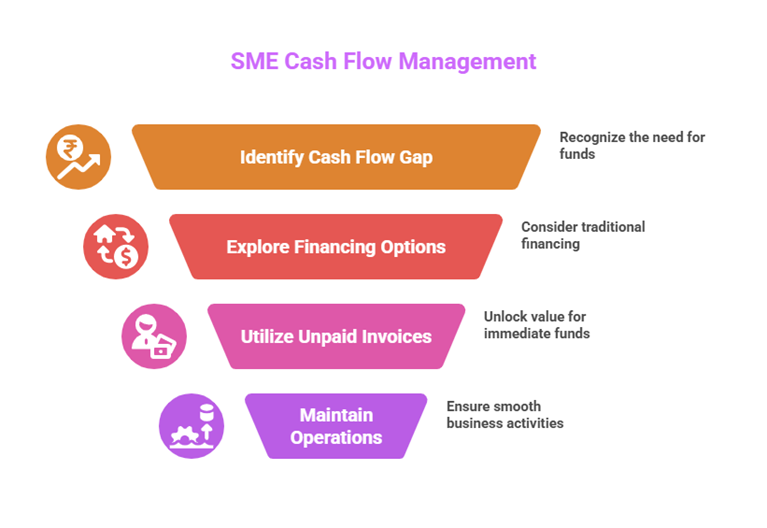
How fintech helps with cash flow management is becoming a major concern for businesses dealing with unpredictable cash inflows and late payments. Modern fintech solutions provide automation, faster payment systems, and real-time financial visibility, helping business owners avoid cash flow disruptions and make smarter working capital decisions.
What is fintech and how fintech helps with cash flow management
Fintech, short for financial technology, describes software and services that simplify financial processes. When focused on cash flow, fintech platforms automate invoicing, accelerate payments, and provide real-time cash positions so finance professionals and small-business owners can forecast liquidity and react quickly.
Why cash flow management matters
Cash flow is the lifeblood of any organization. Accurate cash flow forecasting and timely access to funds determine whether a business can pay suppliers, meet payroll, and invest in growth.
Poor cash flow management leads to missed opportunities, higher borrowing costs, and stress for finance teams. Fintech solutions help prevent those outcomes by making financial information actionable.
How fintech helps businesses improve cash flow: features and tools
Modern fintech platforms combine several tools to address cash flow challenges. These are the core features that reshape cash management:
Automation and reconciliation
Automation reduces manual work. Fintech can auto-send payment reminders, match bank transactions to invoices, and reconcile accounts, saving time and reducing errors.
Real-time visibility and financial insights
Real-time dashboards show current cash positions across bank accounts and platforms. Finance professionals get insights into inflows and outflows and can track surplus cash or shortfalls instantly.
Faster payments and global payment systems
Integrated payment solutions and embedded finance let customers pay faster and businesses move funds internationally with lower friction, improving liquidity and reducing days sales outstanding.
Cash flow forecasting and predictive analytics
Predictive analytics and cash flow forecasting use historical financial data and AI to project future cash balances and highlight risks, enabling proactive financial decision-making.
Expense, payroll and capital management
Expense management tools and payroll integrations streamline outgoing cash flows. Working capital solutions and short-term financing provide access to funds during gaps.
Key benefits of fintech for cash flow management
- Faster invoice-to-cash cycles through integrated payment systems.
- Accurate cash flow forecasting with predictive analytics and AI.
- Reduced late payments via automated reminders and easy payment options.
- Improved liquidity and access to funds during cash shortages.
- Less time spent on reconciliation and manual bookkeeping.
- Better financial decision-making from real-time insights into cash and inflows and outflows.
Comparison: Traditional finance vs modern fintech platforms
| Feature | Traditional finance | Modern fintech platforms |
|---|---|---|
| Visibility | Periodic reports, delayed | Real-time dashboards with cash positions |
| Invoicing & payments | Manual invoicing, bank transfers | Automated invoices, embedded payment solutions |
| Forecasting | Spreadsheet-based, reactive | AI-driven cash flow forecasting, proactive alerts |
| Reconciliation | Manual matching, time-consuming | Automated reconciliation across bank accounts |
| Access to funds | Bank lending, slow | Instant access via fintech lenders and working capital tools |
Expert insight: why finance professionals trust fintech
Finance leaders increasingly turn to fintech because it turns complex financial data into clear, actionable insights. Predictive analytics and automation let teams focus on strategy rather than clerical work. Modern platforms integrate with accounting systems and bank accounts, so the financial picture is accurate and current.
Experts note that fintech is reshaping how companies manage liquidity and capital management by offering embedded finance options, smarter forecasting, and faster reconciliation.
Practical use cases: how businesses use fintech to improve cash flow
Small retail business
A small shop uses payment solutions and automated invoices to reduce days sales outstanding and collect payments faster after implementing online payment links and reminders.
Growing SaaS company
A SaaS provider uses subscription billing automation and predictive analytics to forecast revenue and manage cash reserves for product development and payroll.
Import/export company
An international trader leverages global fintech payment systems to reduce foreign transfer fees and get real-time visibility across multiple bank accounts for better working capital planning.
Service provider
Professional services firms combine expense management, payroll integration, and reconciliation tools to simplify financial operations and maintain healthy cash positions.
How to get started: simple steps for business owners
- Map current cash inflows and outflows and identify pain points.
- Select fintech platforms that integrate with your accounting and bank accounts.
- Automate invoicing, payment reminders, and reconciliation.
- Enable real-time dashboards and cash flow forecasting tools.
- Use predictive analytics to plan working capital and build cash reserves.
Frequently asked questions about how fintech helps with cash flow management
1. Can fintech really speed up customer payments?
Yes. By offering multiple payment methods, payment reminders, and one-click payment links, fintech reduces friction and shortens the invoice-to-cash cycle.
2. Is real-time cash visibility secure?
Modern fintech platforms use bank-level security and secure APIs to aggregate financial data. Choose reputable providers and check compliance and encryption standards.
3. Will fintech replace my finance team?
No. Fintech automates routine tasks and provides insights so finance teams and business owners can focus on strategy and financial decision-making.
4. How accurate are AI-driven cash flow forecasts?
Accuracy improves with better data. Predictive analytics use historical patterns and real-time inputs to create useful forecasts, but they work best alongside human judgment.
5. Can small businesses afford fintech solutions?
Many fintech platforms offer tiered pricing and tools tailored to small-business owners. The savings from automation and improved liquidity often offset costs.
Conclusion: take control of cash flow with fintech
Fintech is reshaping cash flow and financial management by bringing automation, predictive analytics, and real-time visibility into one ecosystem. Whether you run a small business or lead finance teams, these tools simplify cash flow forecasting, speed up payments, and improve financial health.
Start by evaluating your cash flow challenges, choose modern fintech platforms that integrate with your financial systems, and automate the tasks that drain time. You’ll gain better financial insights and more proactive control over liquidity and working capital.
Ready to improve cash flow? Explore fintech solutions that fit your business and start reshaping your financial processes today.
Best Secure Cloud Hosting Providers for Fintech Startups , Schema Markup for Fintech Services: Complete SEO Guide , Best SEO Agencies for Fintech Companies (2026 Guide)
Leave a Reply